Best Air Compressor Water Separator for Painting & Air Tools

Monika Andro
Garage & workshop equipment editor at WorkshopRanker • About the author
Finding the best air compressor water separator gets confusing fast because listings mix filters, regulators, coalescers, desiccant dryers, and “water traps” without explaining what you actually need for painting or air tools.
The practical goal is simple: keep liquid water, oil mist, and fine aerosols out of your air line so your spray finish stays consistent and your pneumatic tools last longer.
This WorkshopRanker guide is built for clear product comparisons, practical fit checks, and plain-English buying advice before you spend serious money on equipment that needs to work safely and reliably in your shop, garage, driveway, or workspace.
Compare the first three reviewed products at a glance.
Disclosure: As an Amazon Associate, WorkshopRanker may earn from qualifying purchases. We may also earn from other affiliate links. This does not change what we recommend or how we compare workshop equipment.

Most buyers comparing the category
Balanced overall feature set

Value-focused buyers
Strong value for the intended use

Buyers who want stronger features
Higher-spec or more capable configuration
This page compares 5 workshop equipment options, focused on real online-buying decisions:
Next, WorkshopRanker connects each comparison to the most relevant category hub, related equipment comparisons, and practical setup or specification guides so you can check the wider buying context before ordering.
Jump to section
Toggle| Image | Product | Best for | Key feature | View on Amazon |
|---|---|---|---|---|
| 1/2" NPT Air Compressor Water Separator, Industrial Grade 3 Stage Air Drying System with 0-240 PSI Air Regulator, Particulate Filter, Coalescing Filter, Desiccant Dryer, Metal Bowl, Auto Drain1/2" NPT Air Compressor Water Separator, Industrial Grade 3 Stage Air Drying System with 0-240 PSI Air Regulator, Particulate Filter, Coalescing Filter, Desiccant Dryer, Metal Bowl, Auto Drain | Most buyers comparing the category | Balanced overall feature set | View on Amazon |
| 1/2" NPT 4 Stage Air Drying System for Air Compressor, Industrial Grade Oil Water Separator with 0-240 PSI Air Pressure Regulator, Coalescing Filter, Auto Drain, for Plasma Cutter & Painting1/2" NPT 4 Stage Air Drying System for Air Compressor, Industrial Grade Oil Water Separator with 0-240 PSI Air Pressure Regulator, Coalescing Filter, Auto Drain, for Plasma Cutter & Painting | Value-focused buyers | Strong value for the intended use | View on Amazon |
| 1/4 Inch Air Compressor Filter Regulator Combo, Water Oil Separator with Pressure Gauge, Manual Drain, Ball Valve and Bracket AW2000-021/4 Inch Air Compressor Filter Regulator Combo, Water Oil Separator with Pressure Gauge, Manual Drain, Ball Valve and Bracket AW2000-02 | Buyers who want stronger features | Higher-spec or more capable configuration | View on Amazon |
 | 3/8" NPT Air Dryer for Compressor-Air Compressor Water Separator AC3110-03,Double Air Compressor Filter,Air Pressure Regulator Combo,5 Micron Brass Element,Semi-Auto Drain,0-145 psi Gauge3/8" NPT Air Dryer for Compressor-Air Compressor Water Separator AC3110-03,Double Air Compressor Filter,Air Pressure Regulator Combo,5 Micron Brass Element,Semi-Auto Drain,0-145 psi Gauge | A more specific use case | Useful fit for a narrower use case | View on Amazon |
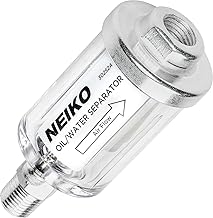 | NEIKO 30252A Water and Oil Separator for Air Line | 1/4" NPT Inlet and Outlet | 90 PSI | Air Compressor and Air Tool Accessory | Protect Lifespan of Pneumatic Tools | Water Moisture Filter DryerNEIKO 30252A Water and Oil Separator for Air Line | 1/4" NPT Inlet and Outlet | 90 PSI | Air Compressor and Air Tool Accessory | Protect Lifespan of Pneumatic Tools | Water Moisture Filter Dryer | Buyers comparing another solid option | Alternative feature and price balance | View on Amazon |
A strong first pick for buyers who want the best all-around match for the job, workspace, and real-world requirements without getting lost in headline specifications.
Best for: Most buyers comparing the category
Key feature: Balanced overall feature set
Watch for: confirm NPT size (this is built around 1/2" lines), regulator range for your tools, and whether you have room to mount a multi-stage assembly where it can drain safely.
| Pros ✅ | Cons ⚠️ |
|---|---|
| ✅ Multi-stage approach helps when a simple water trap isn’t enough for painting | ⚠️ Larger format: you must verify mounting space and line routing |
| ✅ Good baseline for comparing simpler filter/regulator combos | ⚠️ Desiccant systems add consumables and maintenance planning |
| ✅ Better suited to a “system” build than a single in-line filter | ⚠️ Confirm fittings/adapters needed for your compressor, piping, and hose sizes |
Why it’s a top pick: For painting and sensitive air tools, moisture control is usually a system problem because hot, wet air leaves the pump, cools in the line, and then water drops out. With a multi-stage air compressor filter separator setup, you get a more complete path: catch bulk water, reduce aerosols, and dry the air before it reaches the tool.
Decision bullets
WorkshopRanker tip: If you’re chasing paint defects, don’t rely on a single in-line water trap at the gun. Instead, start with correct placement and staged filtration/drying. Use Where To Install Air Dryer Water Separator for layout guidance.
This option earns its place for buyers whose priorities differ from the first pick and who want a stronger fit for a specific budget, workflow, or use case.
Best for: Value-focused buyers
Key feature: Strong value for the intended use
Watch for: confirm the stage layout matches your problem (bulk water vs oil mist vs final drying), and verify you can plumb 1/2" NPT where you plan to mount it.
| Pros ✅ | Cons ⚠️ |
|---|---|
| ✅ Multi-stage approach targets both water and oil carryover concerns | ⚠️ More stages = more fittings, more potential leak points if rushed install |
| ✅ Good fit when you’re building a dedicated air prep station | ⚠️ Verify drain type (auto vs manual behavior) matches your workflow |
| ✅ Helps separate “regulation” from “clean air delivery” in one assembly | ⚠️ Still requires correct placement and cooling distance to work well |
Why it’s a top pick: If your main issue is recurring moisture or oil contamination (not just occasional tank water), a more involved air line water separator setup can be the smarter buy than stacking random in-line filters at the end of the hose.
Decision bullets
WorkshopRanker tip: If you’re unsure whether you need a dryer or just a water trap for air compressor use, compare concepts first using Air Dryer Vs Water Separator.
A practical shortlist option for buyers who care about repeatable results, useful performance, and the specifications that matter most for this category.
Best for: Buyers who want stronger features
Key feature: Higher-spec or more capable configuration
Watch for: this style is often installed near the point-of-use; it can’t replace proper upstream cooling and draining if your compressor produces a lot of hot, wet air.
| Pros ✅ | Cons ⚠️ |
|---|---|
| ✅ Combines regulation + filtration in one convenient point-of-use assembly | ⚠️ Not a full “dry air” solution for demanding paint work by itself |
| ✅ Helps keep tool pressure consistent when line pressure fluctuates | ⚠️ You must match the 1/4" NPT size to your hose/fittings |
| ✅ Practical for benches, small shops, and dedicated air drops | ⚠️ Manual drain means you need a routine to empty it |
Why it’s a top pick: Many buyers shopping for an air compressor water separator actually need two things at the tool: stable pressure and basic moisture/oil capture. With a filter/regulator combo, you can improve repeatability for air tools and light spray work when your upstream system is already reasonably managed.
Decision bullets
WorkshopRanker tip: For paint work, a point-of-use unit works best as the “last step,” not the only step. See Air Compressor Setup For Painting for a simple system layout.
This pick makes sense when fit, compatibility, size, installation, portability, or workspace constraints matter as much as raw performance.
Best for: A more specific use case
Key feature: Useful fit for a narrower use case
Watch for: verify 3/8" NPT matches your line size at the install point, and confirm the gauge range aligns with your normal regulated pressure.
| Pros ✅ | Cons ⚠️ |
|---|---|
| ✅ Good middle-ground sizing for many shop air drops and hose reels | ⚠️ Gauge/regulator limits must match your tools and compressor settings |
| ✅ Combines filtration and regulation to simplify a work bay | ⚠️ Semi-auto drains still require correct orientation and periodic checks |
| ✅ Useful when you want a dedicated station for one work area | ⚠️ Not a substitute for upstream tank draining and cooling distance |
Why it’s a top pick: A common buying mistake is choosing a great air compressor moisture separator that simply doesn’t match your shop’s line size or mounting space. With this option, you focus on the “it has to fit and plumb easily” problem while still getting filtration and pressure control at the station.
Decision bullets
WorkshopRanker tip: If you’re building a full drying setup, decide first whether you need a dedicated dryer upstream. Then use a point-of-use filter/regulator as the “final polish.” Compare options at Best Air Compressor Dryer.
A useful alternative for buyers who want a different balance of capability, ownership cost, or convenience than the options above.
Best for: Buyers comparing another solid option
Key feature: Alternative feature and price balance
Watch for: confirm the PSI limit and that 1/4" NPT matches your hose and tool setup. In practice, this is usually a point-of-use water trap for air compressor lines, not a full shop air treatment station.
| Pros ✅ | Cons ⚠️ |
|---|---|
| ✅ Simple in-line protection for many common air tool setups | ⚠️ Limited drying capability compared with multi-stage or desiccant systems |
| ✅ Easy way to add a compressed air moisture separator near the tool | ⚠️ Must be drained/maintained to stay effective |
| ✅ Good choice when you want fewer parts and fast installation | ⚠️ For paint-quality air, you may still need upstream filtration/drying |
Why it’s a top pick: Not everyone needs a wall-mounted multi-stage system. For most buyers who want basic protection for pneumatic tools (and already drain the tank and manage hoses), a straightforward air line water separator can be the best value with the least hassle.
Decision bullets
WorkshopRanker tip: If your main compressor job is tires, you may not need a complex air compressor filter separator setup. Instead, start by matching compressor output to tire work at Best Air Compressor For Tire Inflation and Air Compressor Size For Car Tires.
To recommend equipment that makes sense for online buyers, we focus on what changes real use and ownership:
Don’t buy this if…
Buy this if…
A water trap for air compressor use that’s “fine for impacts” may fail for painting because paint defects can come from tiny moisture/oil aerosols. However, a heavy multi-stage system may be unnecessary if you only run short bursts and drain your tank consistently.
For an air compressor water separator, the most important “specs” are often about system fit and function, not raw numbers. Focus on what contamination it targets, where it installs, and whether you can drain and service it easily.
Most problems come from installation details: wrong NPT size, no room to service the bowl, mounting where it can’t drain, or placing it too close to the compressor where the air is still hot and wet. Before you order, verify dimensions, orientation requirements, and the fittings you’ll need.
If two products solve the same job differently, use the related WorkshopRanker comparison and setup guides supplied with the page to understand the tradeoff.
Look for practical ownership details: sturdy mounting, easy-to-read gauges (if included), accessible drains, and bowls that are protected from shop impacts. Also, confirm what comes in the box (brackets, valves, gauges) so you don’t delay your install waiting on extra fittings.
Multi-stage systems can mean better air, but they also mean more elements to service and more potential leak points if you rush installation. If the unit uses filter elements or desiccant, confirm how replacements are sourced and how often you’ll realistically maintain it.
Compressed air systems involve stored energy and pressure, so stay within rated limits. Use proper fittings and sealant, and follow the manufacturer’s instructions for mounting, draining, and bowl handling. If you’re unsure about layout, start with Where To Install Air Dryer Water Separator.
| Concern | Likely cause | What to check before buying |
|---|---|---|
| Water still shows up at the tool | Separator is installed too close to the compressor or there’s no cooling distance | Confirm placement and add cooling/drip legs; use Where To Install Air Dryer Water Separator |
| Paint fisheyes or finish defects persist | Oil aerosols or water vapor are passing through a basic trap | Consider coalescing and/or desiccant drying; compare with Air Dryer Vs Water Separator |
| Pressure drops at the tool | Undersized fittings or restrictive point-of-use assembly | Match NPT size (1/4" vs 3/8" vs 1/2") and avoid bottlenecks |
| Leaks around fittings after install | Thread sealing, overtightening, or mismatched threads | Verify NPT compatibility and use correct sealing method per manufacturer instructions |
| Separator bowl fills quickly | Tank not drained, high humidity, long run times, or inadequate upstream separation | Check compressor tank draining routine and whether you need staged separation |
| Results vary day-to-day | Humidity swings and inconsistent maintenance/draining | Confirm drain type, service access, and whether a dryer stage is needed |
| Feature list feels confusing | Mixing up “filter,” “separator,” “coalescer,” and “dryer” terms | Start with the job: air tools vs paint-quality air; use Air Dryer Vs Water Separator |
Use the related WorkshopRanker guides below for deeper category-specific sizing, compatibility, setup, maintenance, and safety questions.
If the PAGE SPEC includes a sizing, specification, compatibility, comparison, setup, or maintenance guide, use the most relevant supplied [GUIDE:] placeholder naturally in this section.
For most buyers, the fastest improvement comes from correct system layout. Use Where To Install Air Dryer Water Separator first, then refine your approach with Air Dryer Vs Water Separator.
Category hub: Compressed Air Pneumatics hub
Related comparisons: Best Air Compressor Dryer and Best Air Compressor For Tire Inflation
Setup and fit guides: Where To Install Air Dryer Water Separator, Air Dryer Vs Water Separator, and Air Compressor Setup For Painting
Sizing help for tire-focused compressor use: Air Compressor Size For Car Tires
Start with the exact job (painting vs air tools), then choose the right type of air compressor water separator: a basic trap for bulk water, coalescing for fine aerosols/oil mist, and desiccant-style drying when you need drier air. Next, match NPT size, placement, and drain/service access.
You need enough capacity to avoid restricting flow to your most demanding tool and to keep up with your duty cycle. Bigger isn’t automatically better, but undersized fittings and tiny point-of-use units can create pressure drop and frustration—especially with spray guns and high-demand air tools.
Prioritize the specs that translate directly to your install: NPT inlet/outlet size, rated pressure range, drain type, and what filtration stages are included (particulate/coalescing/desiccant). Because marketing terms vary, confirm what the unit actually is: air line water separator, air compressor filter separator, or dryer-style system.
Check NPT size (1/4", 3/8", 1/2"), mounting orientation, bowl clearance for service, where it fits in your piping/hose reel setup, and whether you need adapters. Finally, confirm the unit’s pressure rating covers your compressor and regulated tool pressure.
Often yes for painting-quality air and frequent use, because better staged filtration and drying can reduce rework and tool issues. For occasional DIY air tools, a simpler compressed air moisture separator can be the better value if it’s installed correctly and maintained.
Yes—if the listing clearly states NPT size, pressure range, what stages are included, what’s consumable, and what accessories come in the box. For heavier wall-mounted systems, also confirm return terms and whether replacement elements/desiccant are easy to source.
For a water trap for air compressor use, the big features are correct stage type (trap vs coalescing vs desiccant), easy draining, service access, leak-resistant installation, and correct placement in the system. Extras like gauges and brackets matter only if they fit your workflow.
Confirm: (1) your line size and fittings, (2) mounting space and bowl clearance, (3) drain method and where the drained water will go, (4) whether you need paint-dry air (dryer) or just bulk separation, and (5) consumables and replacement parts for the air compressor filter separator system you choose.
If you want the safest first choice, start with Pick #1 because it gives you the cleanest baseline for job fit, useful specifications, compatibility, setup, and ownership risk.
Choose Pick #2 when its focused advantage solves your main constraint better than the overall pick.
Choose Pick #3 when a more specialized performance or workflow profile matches the job.
Choose Pick #4 when its capacity, format, or compatibility is the better fit for your workspace.
Choose Pick #5 when value, simplicity, or a narrower use case matters more than premium extras.
For more context, continue with the related WorkshopRanker category hub and guides listed above.